Infinity DSP.
A suite of on-device processing — remaster to DSD, color your sound with classic analog character, and watch it move. The coloration engines run in Infinity Pure mode.
DSD Remaster Engine
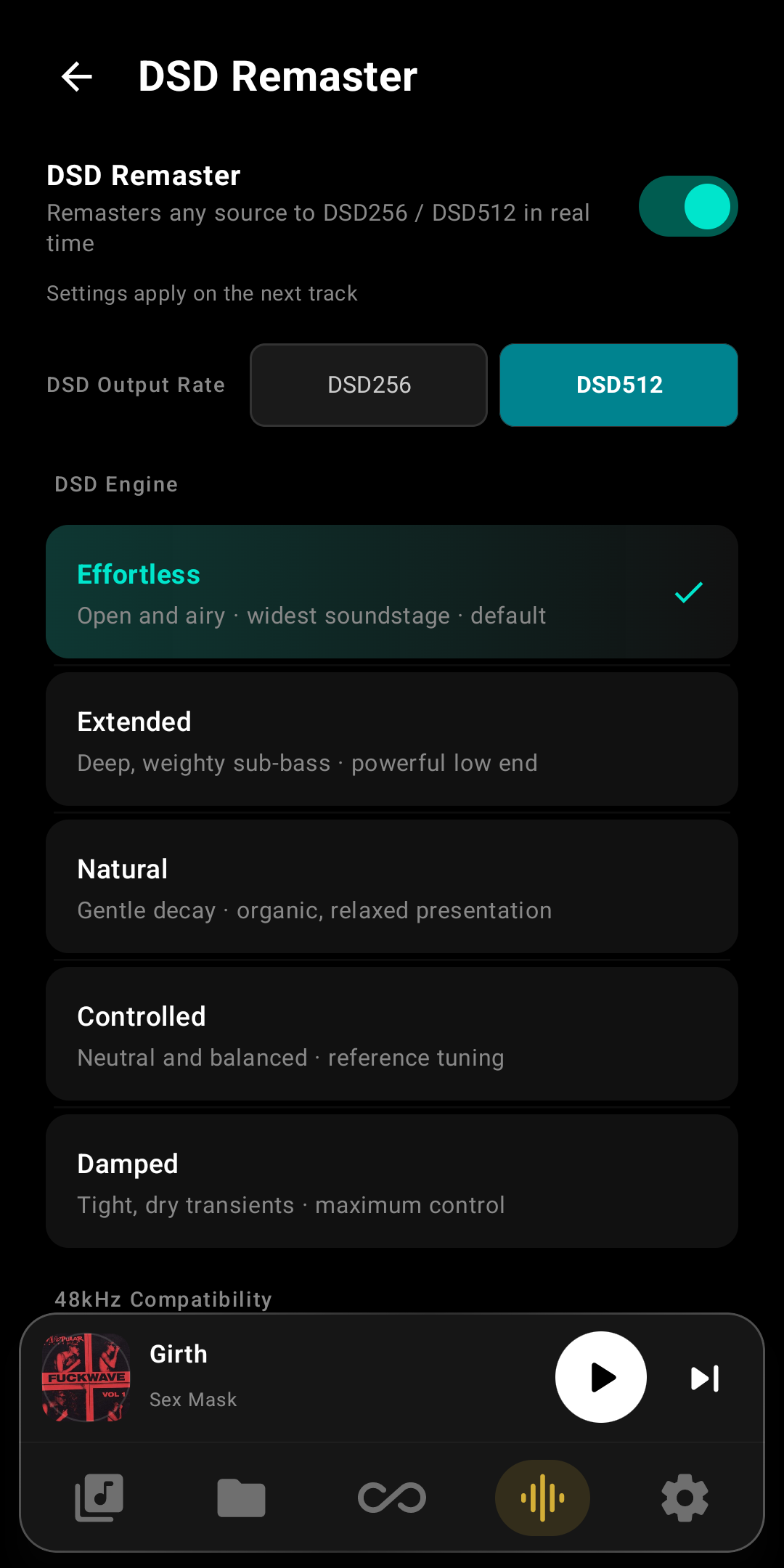
Remaster any PCM track to DSD512 in real time, on-device. Five DSD Engine modes let you tune the character — from open and airy to tight and controlled.
- Five DSD Engine modes — Effortless, Extended, Natural, Controlled, and Damped, each with its own character.
HRRAI — Neural High-Frequency Reconstruction
On-device AI that rebuilds the high-frequency detail lost in CD-quality masters. It synthesizes the harmonic air above 14 kHz — it does not upsample or add resolution.
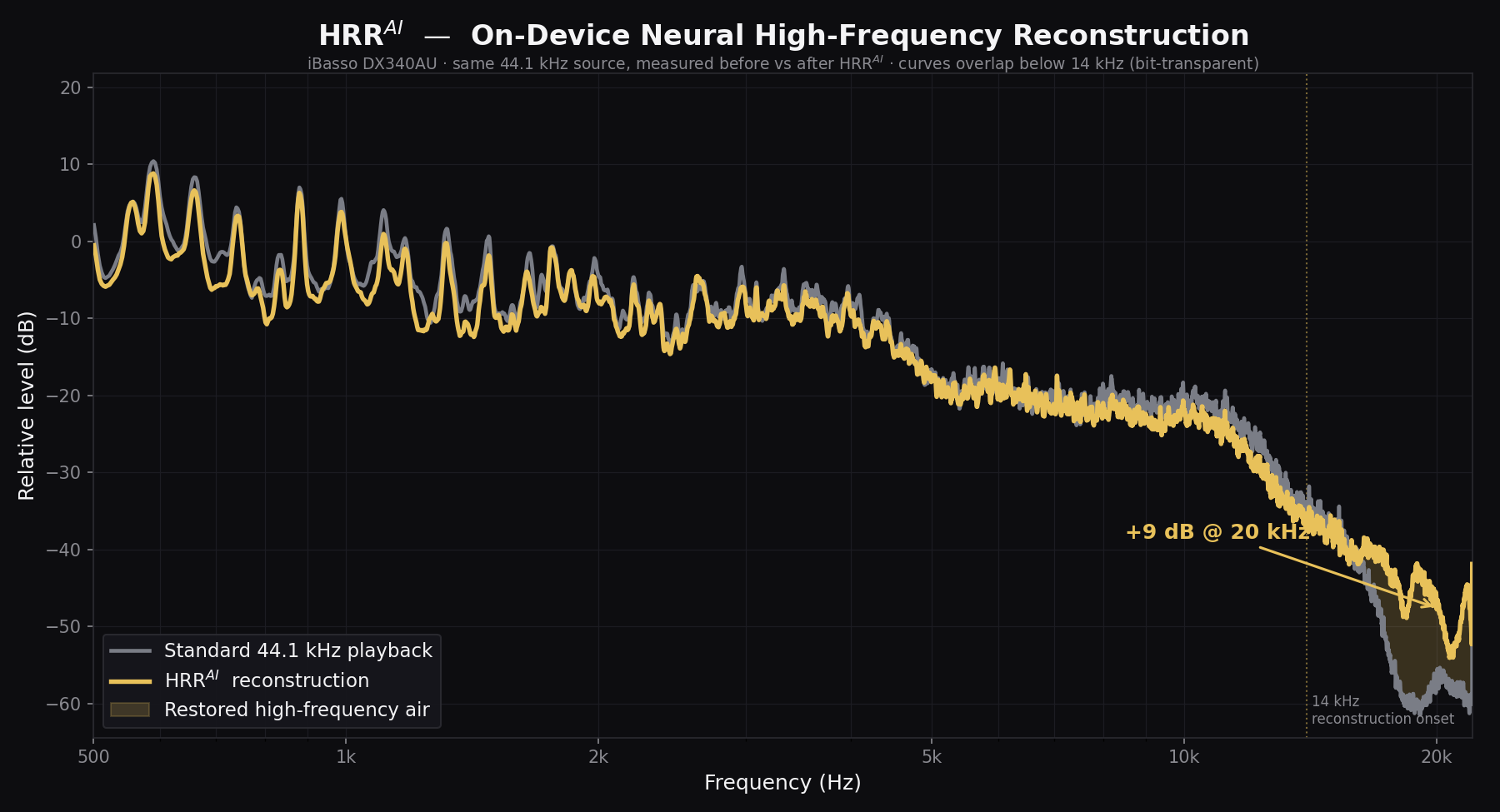
Measured on iBasso DX340AU. Same 44.1 kHz source, before vs after HRRAI. The two curves overlap below 14 kHz (bit-transparent) — HRRAI only synthesizes the high-frequency air above it.
- Runs entirely on the device's GPU — no cloud, no upload, real-time during playback.
- A compact neural network trained to synthesize the harmonic air above 14 kHz that standard 44.1 / 48 kHz sources roll off.
- No upsampling, no rate conversion — it adds spectral content only; everything below 14 kHz passes through bit-transparent.
- Measured on the DX340AU: +8 dB at 18 kHz, up to +12 dB at 20 kHz of restored high-frequency energy.
- Two models — HRR (light) and HRReX (full) — auto-selected by the player.
HRRAI engages on 44.1 kHz and 48 kHz sources. Hi-Res and DSD already carry full bandwidth and are passed through untouched. Requires Infinity Pure mode.
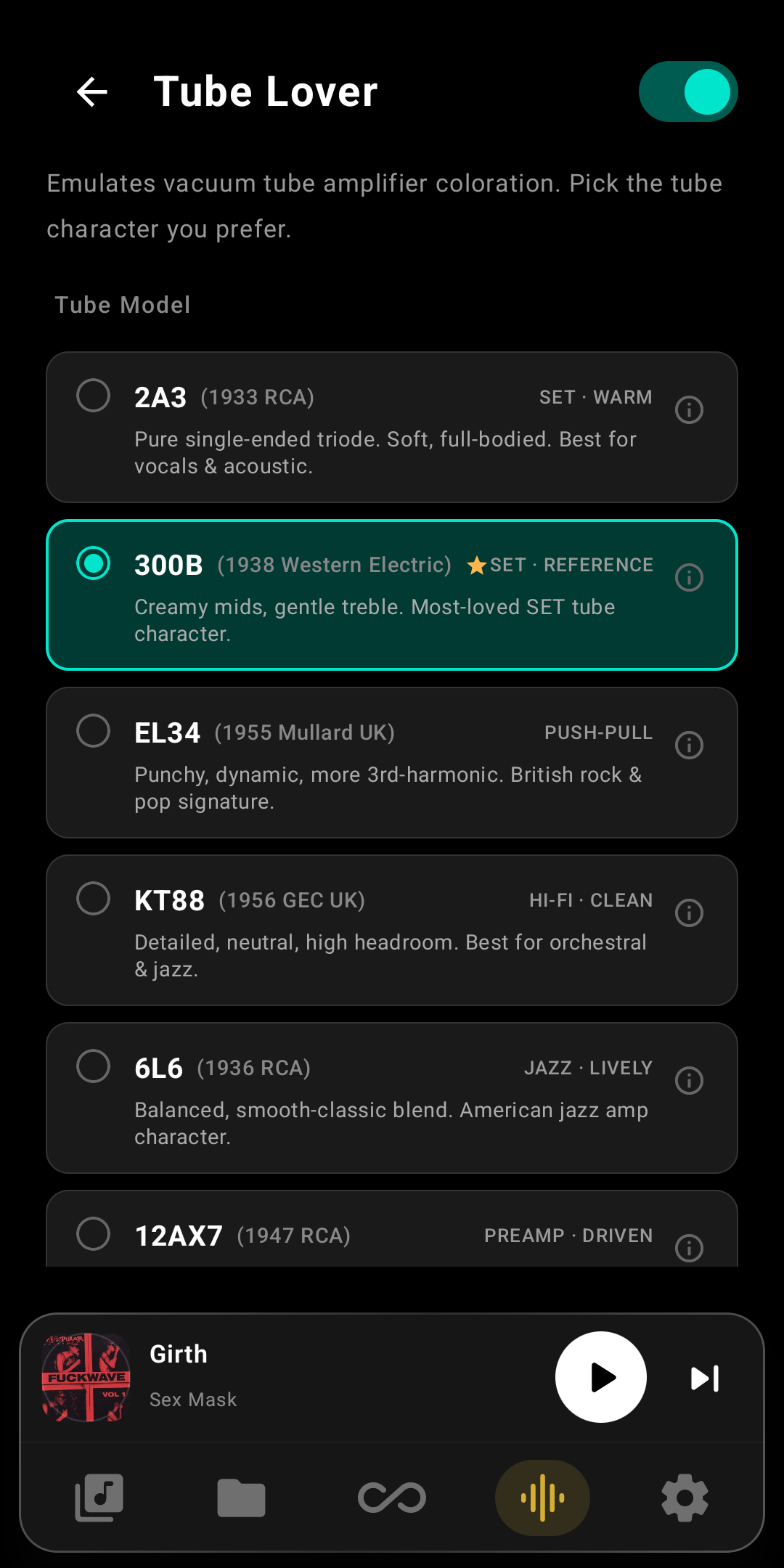
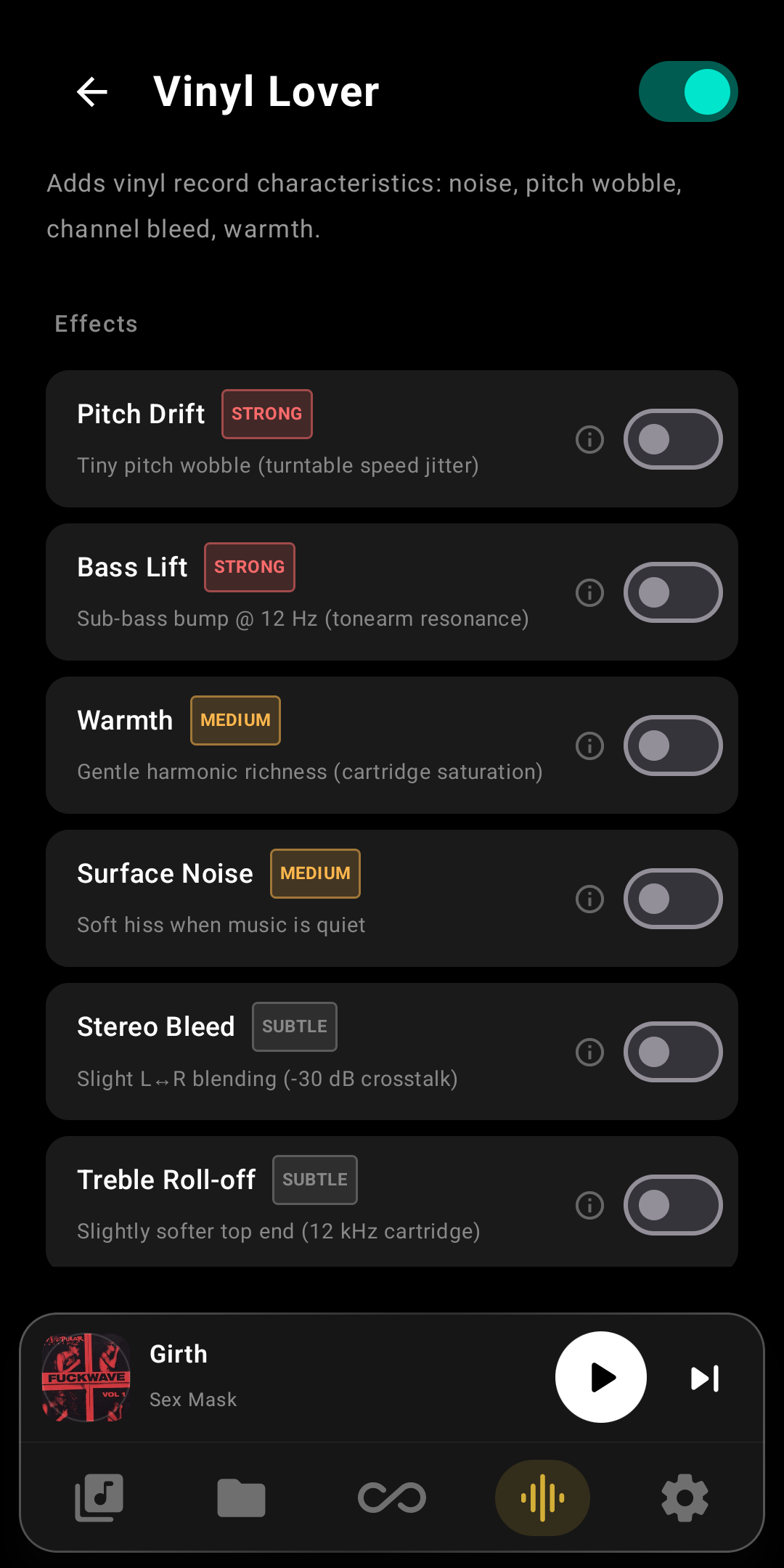
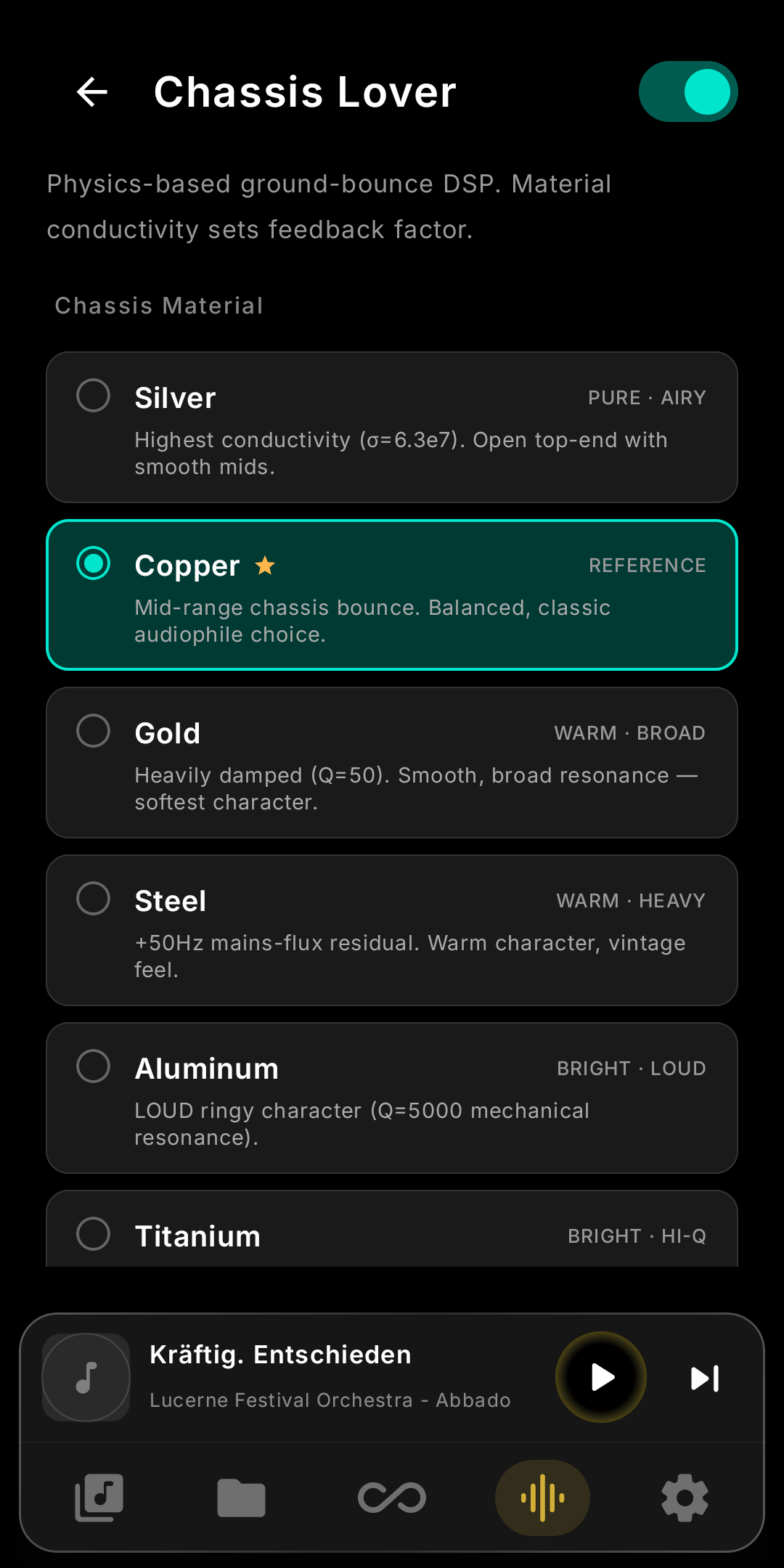
Tube & Vinyl Lover
Add the character of classic analog gear on top of your source — tube-amp warmth, the texture of a turntable, or the resonance of a metal chassis. Runs in Infinity Pure mode.
Crossfeed
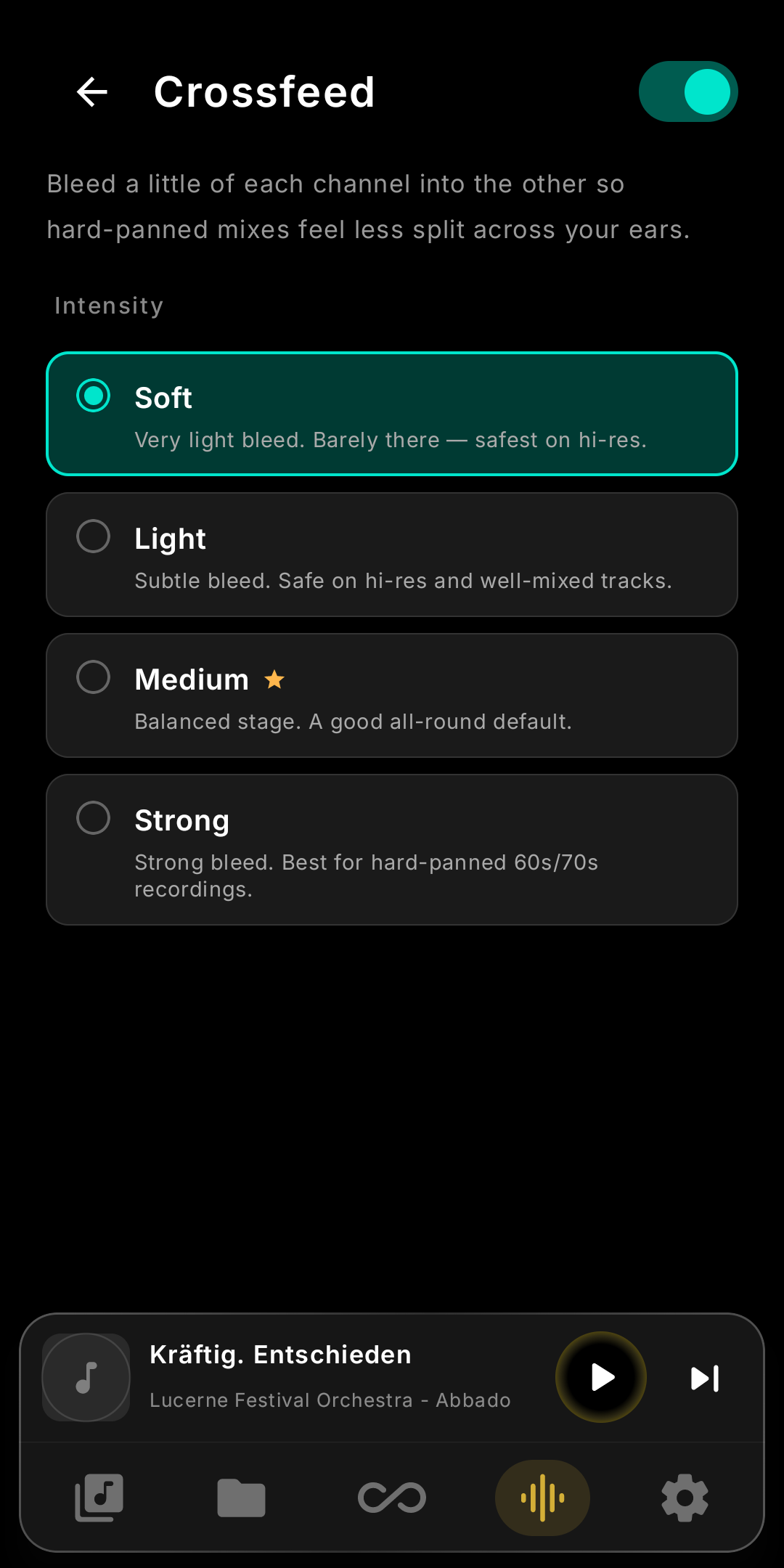
Bleeds a delayed, low-passed copy of each channel into the other, easing the harsh hard-panned stereo of headphones toward a more natural, speaker-like stage. Four intensity presets, running in Infinity Pure mode.
- Soft — very light bleed, barely there. Safest on hi-res.
- Light — subtle bleed, safe on hi-res and well-mixed tracks.
- Medium — a balanced stage and a good all-round default.
- Strong — the widest bleed, best for hard-panned 60s / 70s recordings.
Invert Phase
Flips the absolute polarity of both channels — the whole waveform turned upside down. Some pressings, transfers and mixes end up cut out of phase; one toggle puts them back the way they were meant to sit.
- Switch and listen — toggle it during playback and trust your ears; on some systems and recordings the difference is obvious, on others it is not.
Infinity FPGA
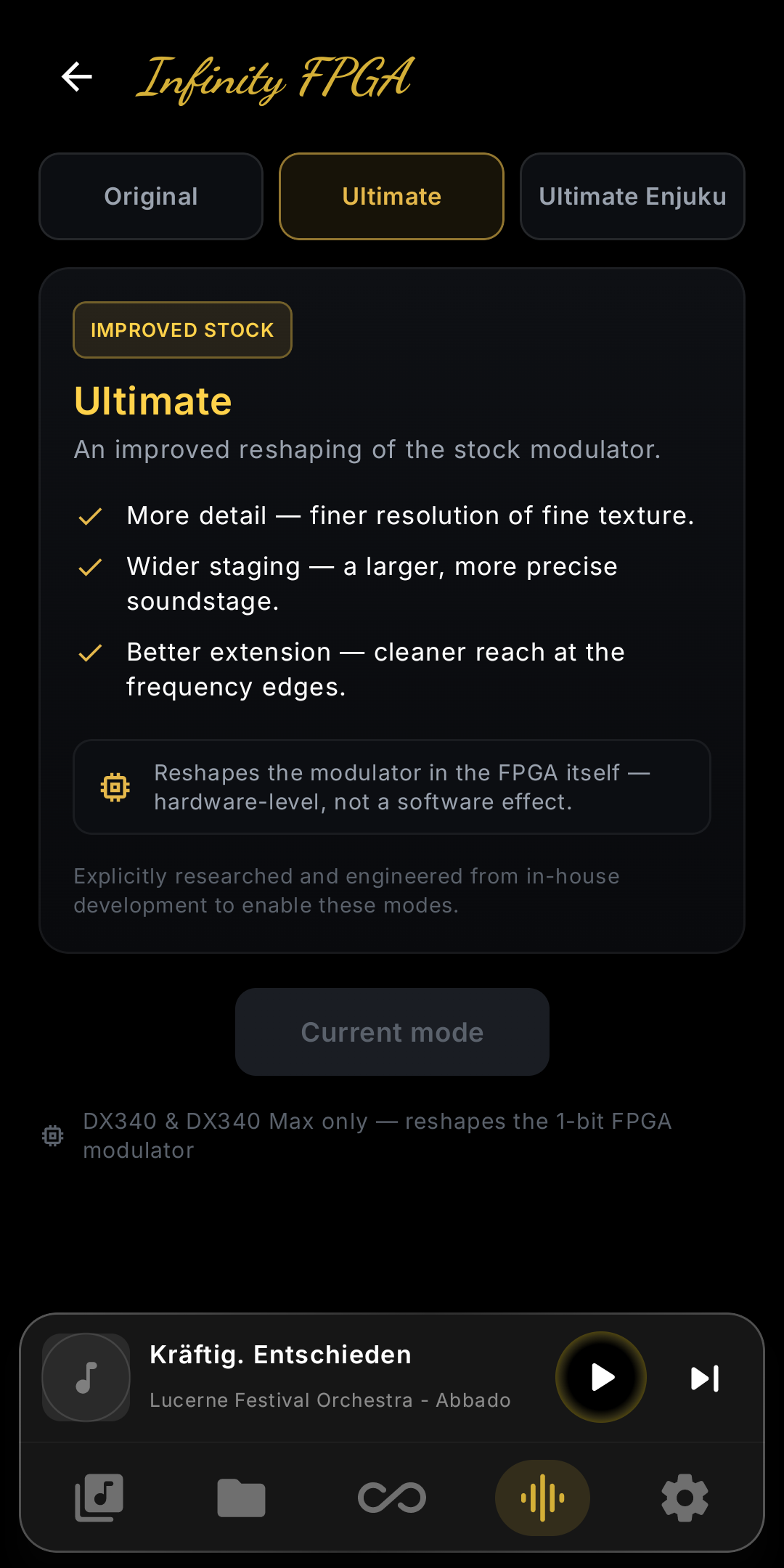
Reshape the 1-bit ΣΔ modulator inside the FPGA silicon. Infinity FPGA live-splices a different bitstream into the Gowin GW1N that shapes every sample on its way to the discrete DAC — a hardware-level change below the DSP chain, not a filter on top of it. DX340 and DX340Max only.
- Original — the stock iBasso modulator, untouched. The reference point, and what the player restores whenever you switch back.
- Ultimate — reshapes the stock modulator in silicon for −13 dB THD. A cleaner shaping curve into the same discrete DAC — the mode most people will want to live on.
Applying a mode rewrites the live boot kernel and verifies the spliced region before it commits; the genuine stock bitstream is captured on first run so Original always comes back. Engineered in-house. Requires the DX340-family ΣΔ modulator — the DX270’s FPGA is a FIR fabric, and the DX320MAX’s and DX180’s handle only SPDIF and clocking, so none of them offer the mode.
See the Music Move
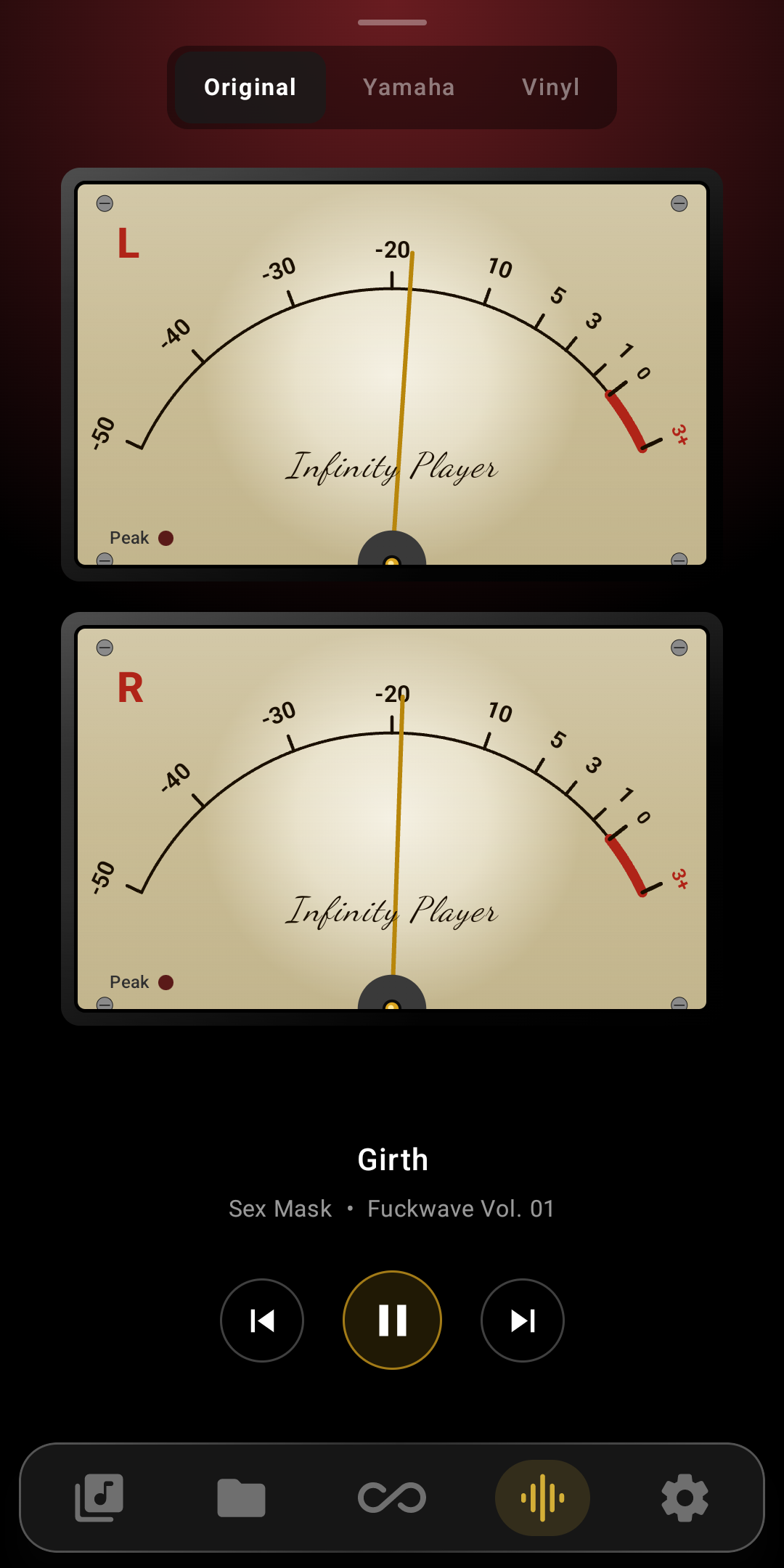
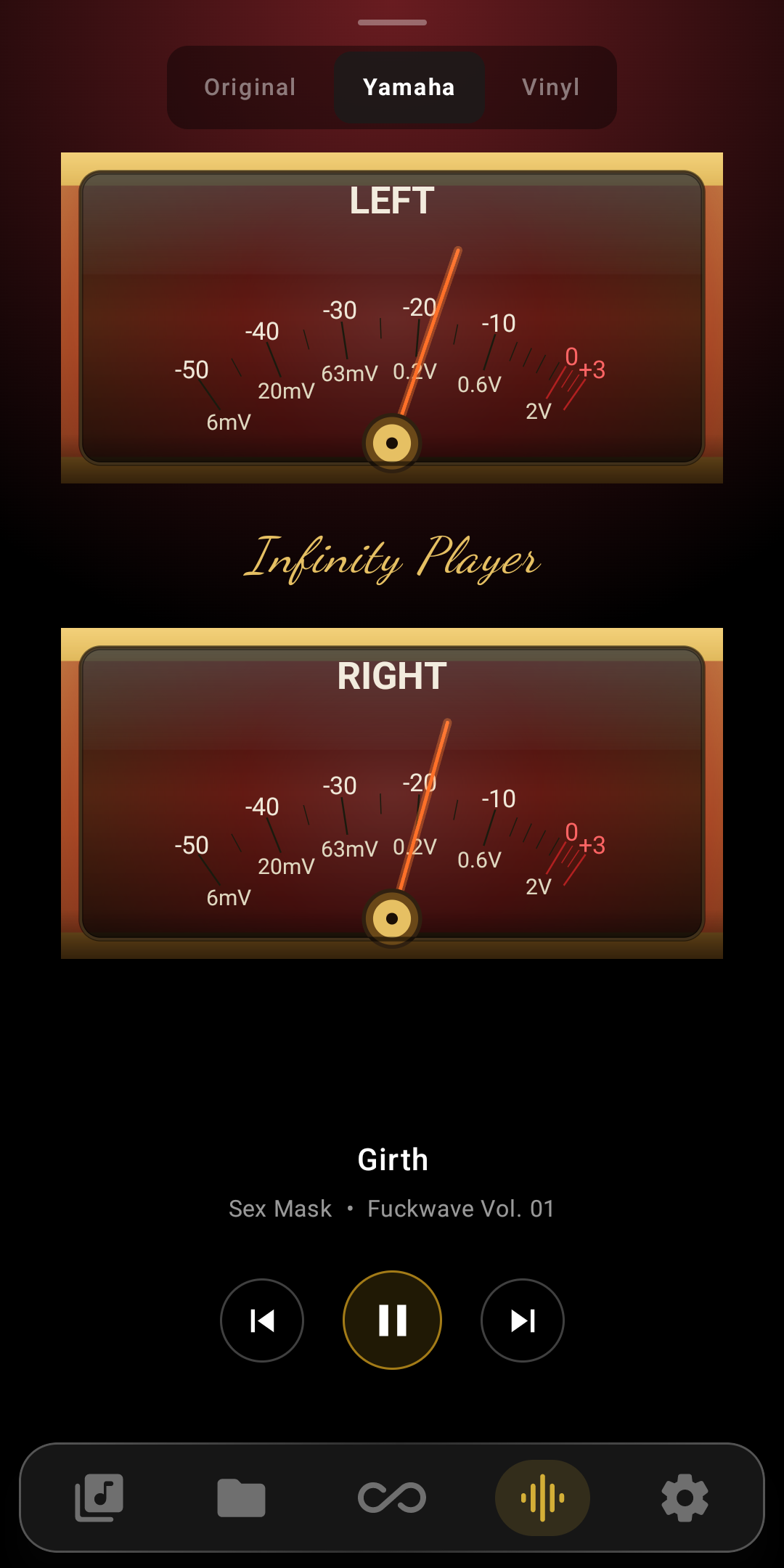
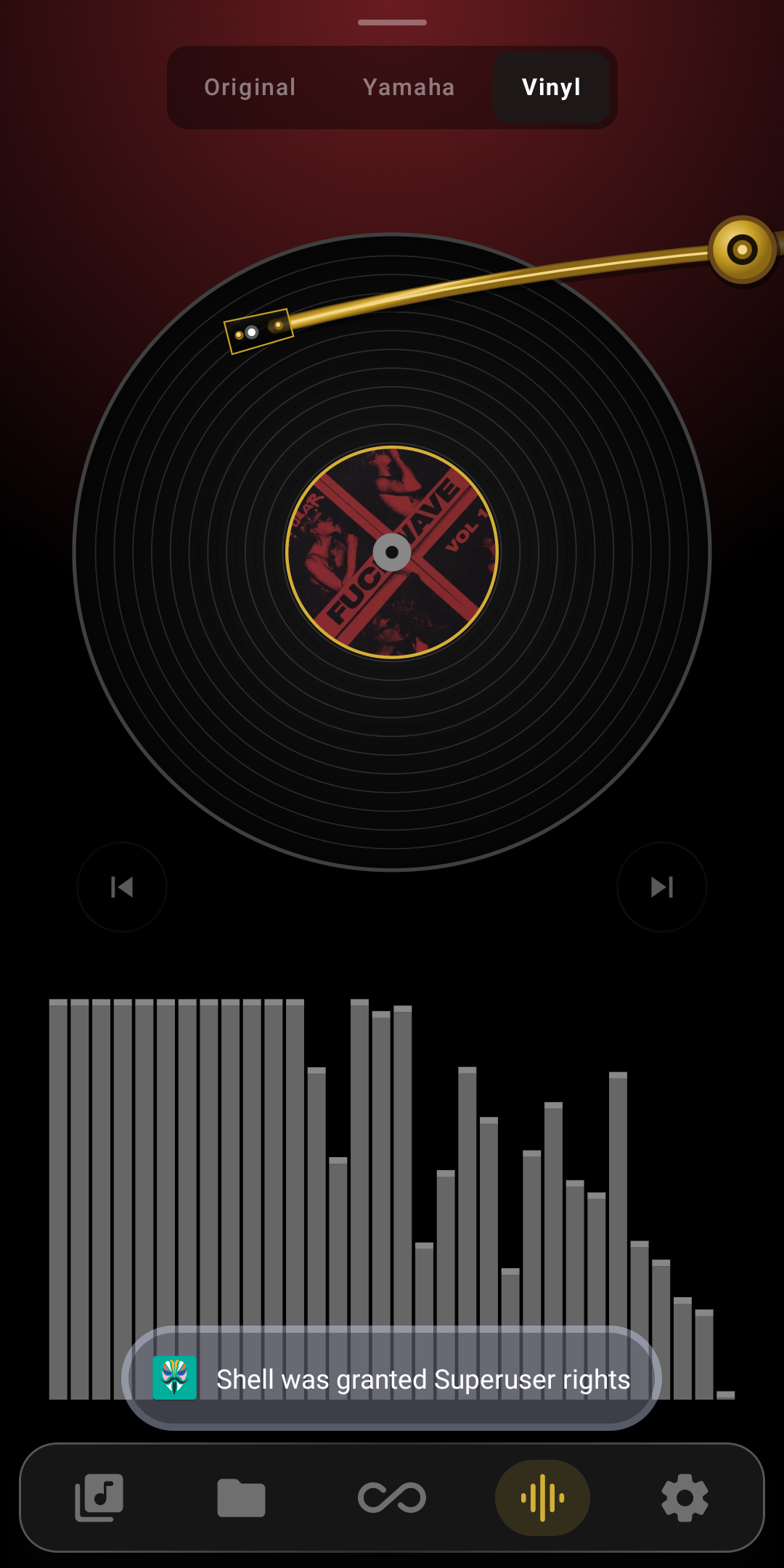
A real-time twin-needle VU Meter and a spinning vinyl visualizer — analog-style metering that reacts to every track.